
Research overview
SNL-CA (Symbolic Neuron Link Cognitive Architecture) is a neural–symbolic research framework authored and developed by Edgar Chraghyan. It explores a central question: can a language-system component choose not only a contextual representation for a token but also a task-relevant semantic route, memory region, symbolic rules and trainable parameter subset? The accompanying mathematical monograph describes the proposal as an architecture and a continuing research programme.
One token, multiple semantic paths
The same token may refer to different concepts in different contexts. Rather than treating that distinction as only an updated contextual embedding, SNL-CA proposes explicit route-conditioned states. An example is the token 'star': its relevant connections differ between astrophysics, a rating system and a graphical symbol. This is a proposed architectural distinction, not a claim that contextual meaning was first discovered by SNL-CA.
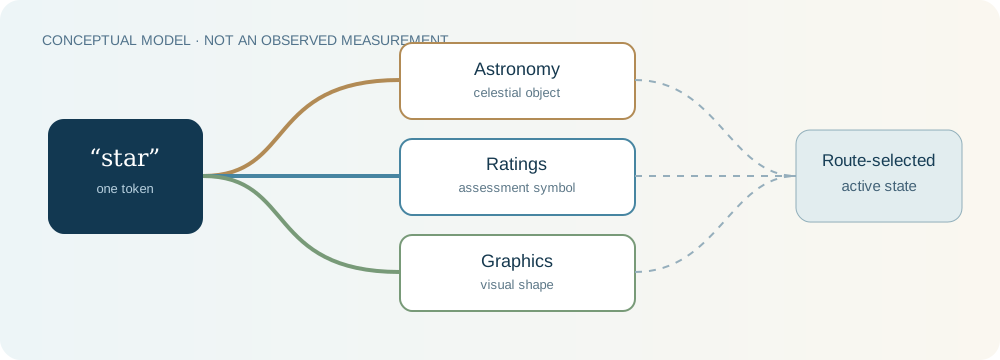
Route selection as a mathematical model
The route selector can depend on the token, surrounding context, graph and memory state. The mathematical notation below expresses the proposed selection principle, with candidate routes evaluated by a context-dependent distribution.
Here, x represents the current token-related input, c the context, M the accessible memory, G the symbolic graph and q the routing model. The selected route conditions which internal information is accessed for downstream computation.
Selective gradient flow
In the proposed training strategy, updates are concentrated on active route-specific parameter subsets. The route mask can be hard or softly weighted, allowing a study of when localized learning reduces interference between semantically different token usages.
This equation is a high-level formulation: its computational consequences depend on router design, data, optimization stability and hardware implementation.
Symbolic structure and addressable memory
SNL-CA combines neural states with a typed symbolic graph and a proposed memory system spanning working, episodic, semantic and rule-based information. Memory retrieval is conditioned on the selected semantic path. A symbolic validation stage is intended to check constraints and identify contradictions before a route is accepted.
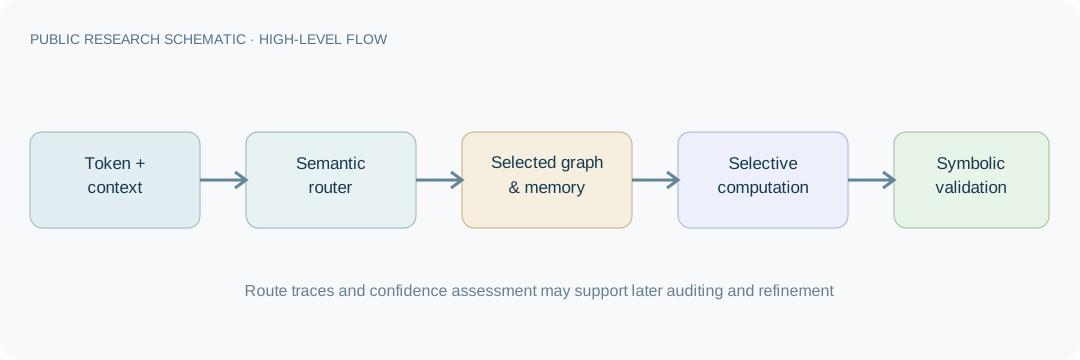
Computational complexity:
Selective activation may reduce work when the active route set and graph neighbourhood remain much smaller than the full candidate space. These formulae are schematic asymptotic descriptions: actual speed depends on routing overhead, memory traffic, precision, batching and communication costs.
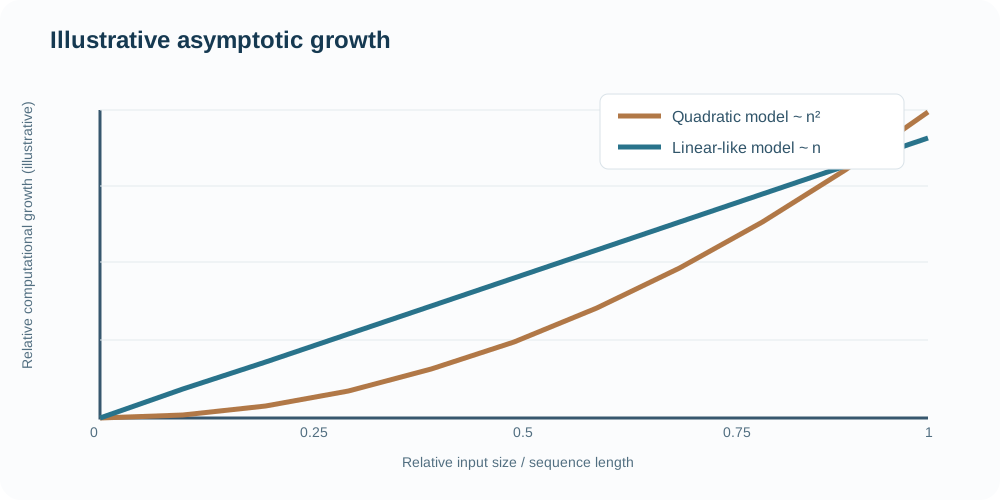
While the chart models normalized mathematical growth under simplified assumptions rather than measured SNL-CA throughput, the monograph projects a vibrant 8–10× speedup target. Realizing this substantial acceleration as an authorial research goal still requires independent, reproducible, and quality-matched benchmarking.
Mathematical models & visualizations
Figures are theoretical or illustrative unless explicitly marked as measured experimental data.
\nabla_{\theta_p} L = m_p\,\nabla_{\theta_p} L,\quad m_p\in[0,1]\rho^* = \operatorname*{arg\,max}_{\rho \in \mathcal{P}} q_{\phi}(\rho\mid x,c,M,G)